

Spring Commonplace
Recent reads and work

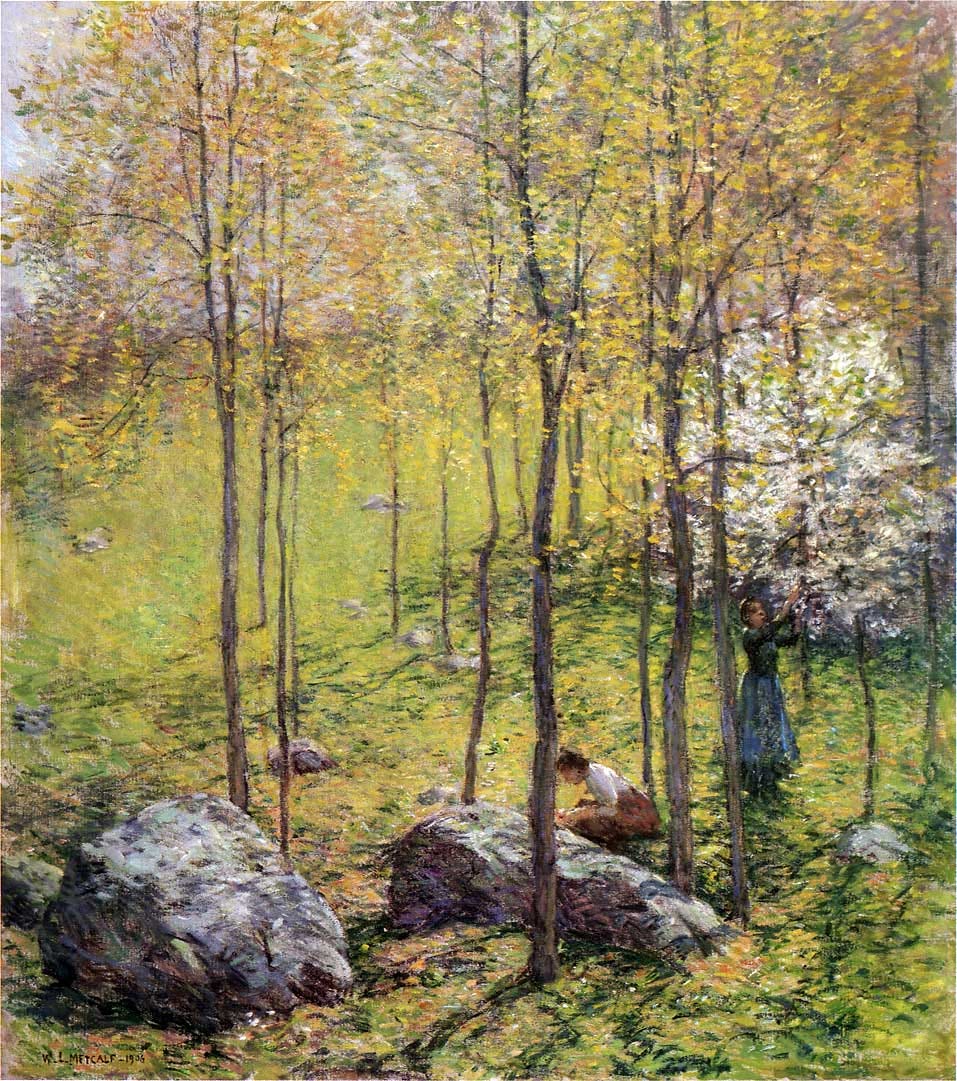
I understand to some extent why the poet T.S. Eliot famously wrote that “April is the cruelest month,” but I love April, as well as March and May. Now that I’m not in school or working at a school in any capacity, I feel I can truly enjoy the slow but delightful mini-resurrections that this season brings.
All the same, spring goes by too fast, in my opinion. One moment the first green grass appears, the next the dogwoods are blooming, then all of a sudden, it’s nearly Memorial Day.
Even as summer approaches, I thought I would gather some of the highlights from my reading over the past few months and share them here with you. I read several books recently that I cannot recommend, such as How About Now: Poems by Kate Baer (figured I would check out what the popular poets these days are doing and was not impressed) and Natality: Toward a Philosophy of Birth by Jennifer Banks (expected a philosophical account but found instead profiles of several progressive and/or transgressive thinkers who wrote or thought a little bit about birth). And I read several others that were lovely but that I will not recount here for brevity’s sake.
Books
Descent into Hell by Charles Williams
Williams’ book made for good Lenten reading this year. Williams was an oft-overlooked member of the Inklings. He had some unusual philosophical and theological fixations, and his novel Descent into Hell particularly explores his concept of “substituted love”— how, through love, one can actually bear another’s burdens. Here is one section in which Williams reflects on love through the thoughts of a dying character:
The most perfect, since the most intimate and intelligent, art was pure love. The approach by love was the approach to fact, to love anything but fact was not love. Love was even more mathematical than poetry; it was the pure mathematics of the spirit. It was applied also and active; it was the means as it was the end. The end lived everlastingly in the means; the means eternally in the end.
The Brothers Karamazov by Fyodor Dostoevsky
Another book—this one much longer—that dwells much on love. I finished The Brothers Karamazov this spring after slowly going through it with a book group. It’s the sort of book that rewards re-reading—this was my third time through it, and I appreciated it all the more. The below section strikes me as resonant with Williams:
Active love is a harsh and fearful thing compared with love in dreams. Love in dreams thirsts for immediate action, quickly performed, and with everyone watching. Indeed, it will go as far as the giving even of one’s life, provided it does not take long but is soon over, as on stage, and everyone is looking on and praising. Whereas active love is labor and perseverance, and for some people, perhaps, a whole science.
Sapphics Against Anger and other Poems by Timothy Steele
I was rewarded by my first foray into formalist Timothy Steele’s poetry (I read and learned much from his book on verse, All The Fun’s In How You Say a Thing, while taking a class in the University of St. Thomas’ MFA program). Here’s one favorite poem from the collection, and here’s the title poem.
Theo of Golden by Allen Levi
Everyone seems to be talking about this novel. People I respect loved it; other people I respect very much did not. As I read it, I certainly thought it would have profited from a good editor (as it was self-published), both for fixing grammar mistakes and for cutting out unnecessarily long-winded portions. All the same, I think the novel is worth reading despite its Hallmark-esque premise: as one Substack writer put it, Theo of Golden is a bit like a parable, pointing to truths about God and man in a different way than the greatest works of literary art do.
I wonder if, like newborn children, we go through our entire lives looking for a face, longing for a particular gaze that calms and fills us, that loves and welcomes us, that recognizes and runs to greet us.
Articles/Poems
“Brevity” by Sally Thomas, Talk To Me In Long Lines
It took me a little while to read Sally Thomas’ beautiful sonnet sequence, but it was worth the time (and, I assure you, it would be worth yours, as well!). Thomas reflects on the brevity of life, particularly on the prophetic utterance that “all flesh is grass.”
…Your footprint is a ghost
Upon the grass, yet you don’t cease to be
A something held in one vast patient hand.
“Everyone Is Eventually a Burden” by Matthew Burdette, Plough
A reflection on euthanasia and the concept of being (and bearing one another’s) “burdens.” Burdette particularly considers how we might raise children who will not succumb to societal pressures towards suicide by euthanasia:
Christians who hope to raise children whose bodies and souls can survive this culture must teach their children that there is nothing wrong with being a burden; we must prepare our children to expect to care for us like we once cared for them; we must model what it looks like to bear the burdens of others and to be truthful about how difficult and demanding this kind of Christian love can be.
“Chasing Eden: On the Present Age and the Possibility of Humanity” by Sarah Ashbach, Front Porch Republic
Ashbach’s wonderful reflective essay winds through questions regarding technology and what it means to seek the good life.
You will find that this means embracing the givenness of everyday, which means celebrating its monotony and mundanity. It probably also means forsaking most of our pseudo-myths about progress for the real good of what is rather than the hypothetical good of what could be. I do not sweep my kitchen floor because I believe there will ever come a time, even in the next life, when I shall not need to sweep my kitchen floor. But how good it is that I have a kitchen, how good the food I prepare in it. How good is my husband, the same face smiling at me every morning, the same arms holding me each night. Delight is the heart of God.
“The ‘Clean Sea Breeze’ of Good Novels” by Shelby Arnette, The Bookshop Barista
One of my favorite definitions for the purpose of literature is that is ought to both teach and delight. A good book is not merely a moral rod in one’s back-pocket, nor is it merely fluff. By being an object of beauty, it delights the senses and moves the heart toward what is good.
My Work
A few recently published things from yours truly:
A poem entitled “The Darkness of God” for Modern Age (which is also in my book Home Songs)
A reflection on AI and education
A profile of poet Rachel Hicks for byFaith
A review of Paul Pastor’s poetry collection The Locust Years
An article on pastoral residency programs for byFaith
I enjoyed Theo of Golden as well … and like you found it like a fairytale (I think you said parable). I have been frustrated by all the negativity and then I went and bought some of the popular Emma M Lion books and have found myself not wholeheartedly enjoying them as much as others I respect and having some strong opinions myself! It is a good thing there are so many books in this world to choose from!
You always have so many great links that I enjoy looking through- thank you!
Thank you for the mention! And for many good recommendations as well!